Two Markets, Two Trajectories: Why Şanlıurfa's Real Estate Surge Is Leaving American Property Gains in the Dust
For the better part of two decades, American homeowners operated under a simple assumption: real estate was the safest, most reliable wealth-building vehicle available to the middle class. Buy in Phoenix, hold in Tampa, flip in Nashville—the geography barely mattered as long as the dollar kept moving and the Fed kept rates manageable. That assumption is now under serious pressure.
Meanwhile, in southeastern Turkey, a city of nearly two million people is quietly rewriting what property appreciation can look like when demographic momentum, government investment, and undervalued land converge at the same moment.
The American Freeze: What the Numbers Actually Say
The Federal Reserve's rate-hiking cycle that began in 2022 fundamentally altered the calculus of US residential real estate. The 30-year fixed mortgage rate, which hovered near 3% as recently as early 2022, climbed above 7% and has remained elevated. The result is a market characterized by what economists have taken to calling a "lock-in effect"—existing homeowners refuse to sell because doing so would mean surrendering a historically low rate, while prospective buyers are priced out of monthly payments that have nearly doubled on equivalent loan amounts.
In Sun Belt markets that saw explosive pandemic-era appreciation—Scottsdale, Sarasota, Austin—year-over-year price growth has moderated dramatically or reversed in certain segments. The Case-Shiller National Home Price Index, long the benchmark for American real estate health, has reflected this deceleration across multiple consecutive quarters.
For the American investor accustomed to 6–9% annual appreciation in premium domestic markets, the current environment offers a sobering recalibration.
Şanlıurfa's Acceleration: The Drivers Behind the Data
Set against that backdrop, Şanlıurfa presents a striking contrast. Property valuations in the city's expanding districts have been registering annual appreciation rates in the range of 40–70% in Turkish lira terms, with dollar-adjusted figures varying based on exchange rate movements but consistently outperforming static US markets on a real-return basis.
Several structural forces are propelling this growth:
Demographic Pressure on Supply: Şanlıurfa is one of Turkey's youngest and fastest-growing cities by population. A fertility rate well above the national average, combined with rural-to-urban migration from surrounding provinces, is generating sustained housing demand that the existing stock cannot fully absorb. This is not speculative demand—it is organic, population-driven pressure on a finite housing supply.
Federal Infrastructure Commitment: The Turkish government has designated Şanlıurfa as a priority zone under multiple regional development frameworks, channeling investment into transportation corridors, hospital construction, university expansion, and industrial zone development. Each of these projects functions as a demand multiplier for surrounding residential and commercial property.
Tourism and Archaeological Catalysts: The ongoing excavations at Göbekli Tepe—widely regarded as the world's oldest known monumental structure—have elevated Şanlıurfa's international profile considerably. UNESCO recognition and the completion of a dedicated archaeological park have transformed what was once a regional attraction into a destination drawing visitors from Europe, the Gulf states, and increasingly, North America. Hospitality-adjacent real estate has been among the primary beneficiaries.
Neighborhood-Level Appreciation: Where the Returns Are Concentrated
For American investors evaluating specific entry points, the appreciation story is not uniform across the city. Certain districts are generating outsized returns relative to even Şanlıurfa's already-strong citywide average.
Eyyübiye: The administrative and commercial core of the city has seen consistent demand from professionals, civil servants, and business owners. Properties in established residential pockets of Eyyübiye have appreciated steadily, with the added advantage of lower vacancy risk due to proximity to employment centers.
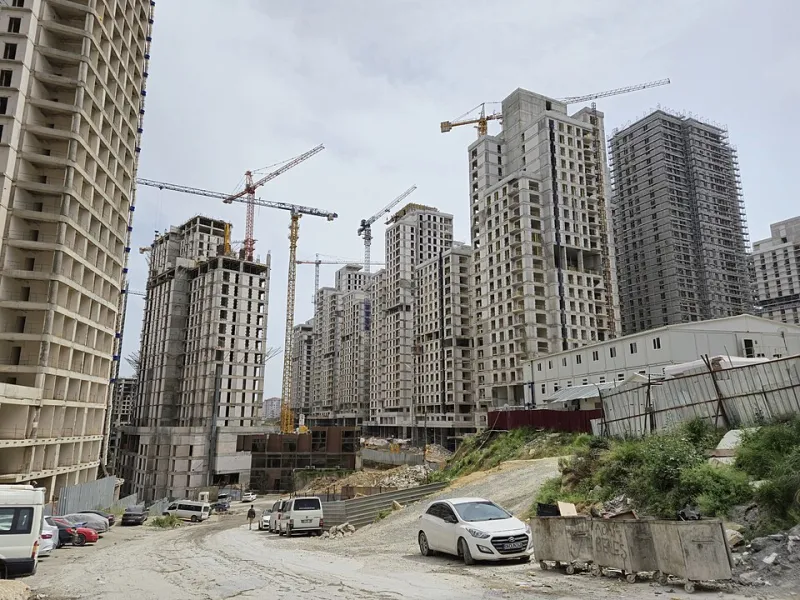
Karaköprü: As one of the city's newer planned development zones, Karaköprü has attracted significant construction activity and young family buyers. Infrastructure investment in this district has been substantial, and land prices in its outer edges remain accessible—presenting an entry-point opportunity for investors willing to hold a medium-term position.
Haliliye: Encompassing the historic center and its surrounding transitional neighborhoods, Haliliye benefits from both heritage tourism and urban renewal funding. Properties here carry the dual appeal of cultural cachet and government-backed renovation incentives, a combination that has driven appreciation in comparable Turkish heritage cities.
The Currency Dimension: A Structural Tailwind for Dollar-Denominated Buyers
Any honest analysis of Turkish real estate from an American investor's perspective must address currency. The Turkish lira has experienced significant depreciation against the US dollar over the past several years, a dynamic that cuts in multiple directions.
For buyers transacting in dollars, lira depreciation effectively reduces the dollar-denominated acquisition cost of Turkish property—meaning that even properties appreciating rapidly in lira terms can be acquired at relatively stable or declining dollar price points. This creates a structural asymmetry: the investor captures lira-denominated appreciation on the asset while having purchased that asset with dollars at a favorable conversion rate.
This is not without risk. Currency volatility introduces complexity into return calculations, and investors should work with financial advisors experienced in cross-border real estate to model scenarios appropriately. However, for those with a multi-year investment horizon and dollar-denominated income, the mechanics are meaningfully favorable.
Comparing the Risk-Adjusted Return Profile
When American investors evaluate Florida or Arizona as investment destinations, they are typically accepting modest appreciation expectations—perhaps 4–6% annually in normalized conditions—in exchange for perceived stability, legal familiarity, and liquidity. The current rate environment has compressed even those modest expectations.
Şanlıurfa offers a different risk-return profile: higher appreciation potential, currency complexity, and a legal framework that, while navigable, requires local expertise. For investors willing to engage that complexity—and sanliurfasatilik.com exists precisely to lower that barrier—the potential returns represent a meaningful premium over what domestic markets are currently delivering.
The divergence between these two trajectories is not a temporary anomaly. It reflects deeper structural realities: an aging, supply-constrained American market operating under elevated financing costs, and a young, undersupplied Turkish city with government-backed growth momentum. Recognizing that divergence early is, historically, how generational wealth is built.